
Harvest projections and weekly flow
Running a market garden is no small feat as there are lots of moving pieces - fluctuating weather, hundreds of unique customers, several staff, and over 100 distinct crops to manage. How do we organize it all? The easy answer is spreadsheets, but the more complicated answer follows. Over the winter as we plan for the coming season, we draft a budget. How many staff will we need, how much will we pay ourselves, what expenses will we incur? We are thrilled to be paying 2 full time staff and paying ourselves for all the hours we work during the main growing season - a first! Once we have a budget, from there we do our best to evaluate where all this money will come from. Our markets are broken down mainly between our Community Supported Agriculture program, a weekly farmer's market and a wholesale account. Once we project our estimated revenue for each outlet, we need to make sure we can actually grow that much food. Before we plant even the first seed, we know (roughly) how many carrots we will be harvesting the second week of October. With information gleaned from years of farming, we try to predict what will go in each week's CSA basket, how many pints of peas our market share want (the answer is lots!), how experimental are our market customers, and how many bags of lettuce we can sell through wholesale, etc. Once these amounts are in place, we can see a) whether or not they satisfy the financial goals we set and b) whether or not they all fit in our fields. It's a tricky balance growing this many crops, but we're grateful for insurance built into the diversity.

Once our harvest projections are complete after lots of tweaking, we work backwards to create an action plan. We know more or less how many days to maturity there are from when an eggplant transplant goes into the soil to when we can harvest eggplant and we know how many days it takes for a seed to become a hearty transplant. This information forms the base of our season. Now we know, when we need to start seeds in the greenhouse and when we need to plant them in the field to harvest them when we want them. Of course, we need to factor in the weather as well. Many of our flowers, for example, are tender annuals, which means that even a lick of frost will kill them, so we cannot plant them outside until we're confident that frost risk has passed. This means that even if we wanted to have bouquets of sunflowers at our first market in May, we cannot accomplish that without a greenhouse. Season extension infrastructure like tunnels, greenhouses, and even row cover or frost cloth can make a big difference, but at the end of the day we still work at the whim of mother nature.
Now that we have a big picture plan for the season, we need to ensure it is successfully executed. For this, we rely both on our handy spreadsheets and on a weekly field walk/ weather check. Every week a master list of tasks including weeding, harvesting, transplanting, trellising, building, irrigating, and more is created. Based on weather and staff schedule, these tasks are divided throughout the week - it is easier said than done! There are a lot of very physical jobs, so we do our best to maintain balance and not burn ourselves out (especially with hot weather like we're experiencing this week).

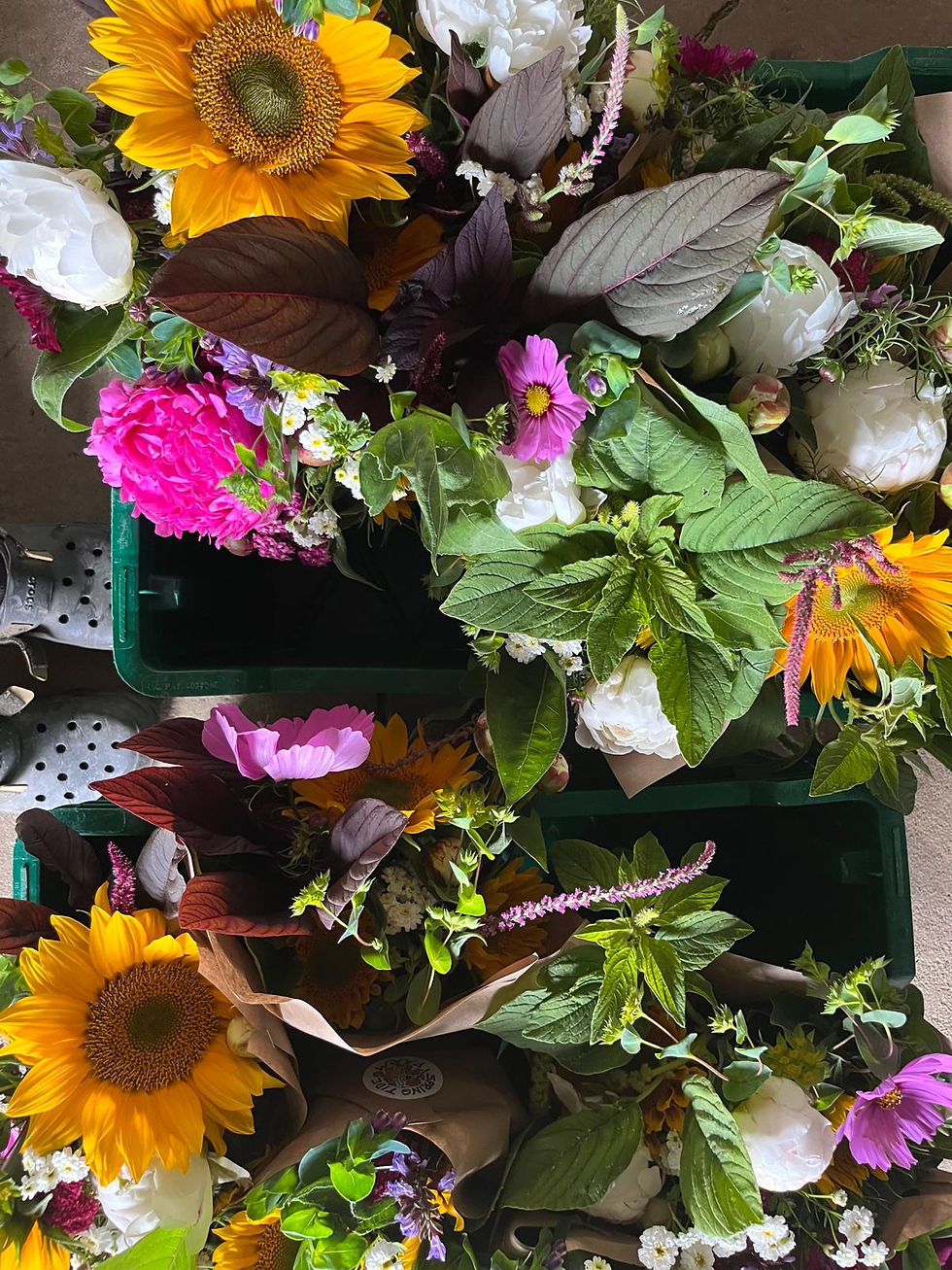
At this time of year, we also need to leave sufficient time to harvest, wash, pack, and deliver the veggies and flowers. With our Tuesday CSA pickups and Thursday farmer's market, we now harvest on Mondays and Wednesdays. Whoever is doing the CSA deliveries on Tuesday will wash/pack, while the rest of us pick away at field work. I mention these details because this flow directly impacts the way we format our CSA ordering. During the Wednesday harvest for the market, all of us closely monitor the crops we are harvesting and then project how much will be available the following week. We do our best the ensure that our CSA members get first dibs on new and exciting crops, though sometimes when the first harvest of zucchini only yields 8 tiny fruits, it makes more sense to send those few to the market. We work hard to avoid gaps and to have enough yield to offer to everyone. It's a complex puzzle and although it's impossible to please everyone all the time, do know that we really are trying! These projections from Wednesday populate the online store that gets shared by email on Thursday mornings. Occasionally, new items will be added after the email goes out, not because we're trying to be tricky, but rather because some things are simply hard to predict! Depending on the temperature and moisture, radishes the size of a pea on Wednesday may be the size of a kiwi come Monday morning. Ordering for pickup on Tuesdays closes on Sunday evenings at 9pm to give me time to compile the orders into a harvest sheet because this whole cycle repeats come Monday morning.
It's not a perfect system, but it works pretty well! Every year we learn from our mistakes and try to become more efficient. With so many moving pieces, it can be easy to overcomplicate things, instead we put a lot of thought into streamlining our processes and into removing waste - why walk back to the barn 15 times for tools when instead we can make a plan for the entire afternoon and bring everything we need with us! We're always evolving, so thank you for learning with us!
Rebecca
Getting tired of the same boring salad? Try a fun new dressing.
I love a classic caesar dressing on lettuce heads or kale. A caesar salad makes an excellent base for a complete summer meal - add a protein of your choice and you're good to go. Here's my go to caesar dressing:
2 part mayo, 1 part oil, 1 part lemon juice
lots of black pepper
a couple anchovies finely chopped
some grated parmesan
A little herb (or a lot!) also goes a long way in spicing up a salad dressing. Try this:
2 parts olive oil
1 part white wine vinegar (or vinegar of your choosing)
salt and pepper
1 clove of garlic
1 spoonful of honey or maple syrup
1 handful of cilantro, dill, parsley, or basil (or all of the above)
Combine in a blender and enjoy!


Comments